Soie — Hand Beauty
Hand Care: How to Take Care of Your Hands Every Day
Hand care is the daily habit of protecting your hands from dryness and roughness. Once you know how the skin on your hands behaves, a routine of wash, moisturise and protect becomes second nature.
Most of us would never skip our face in the morning, yet our hands are left to fend for themselves. They grip, wash, type and carry all day long, and they meet water, detergent, friction and sunlight more than any other part of the body. They are also, by most accounts, the part we look after least.
This page is a complete introduction to hand care: what the term covers, why the skin of the hands dries so quickly, the right order of steps, the moments in the day when moisture matters most, how to adjust the routine for seasons, situations and each decade of life, what each tool is for, and the misconceptions worth leaving behind. Whether you are starting hand skincare for the first time or revisiting an old habit, it should give you a clear picture.
None of it is complicated. The whole routine rests on one small gesture: wash, then moisturise, at the turning points of the day.
Hand care by Soie — cleanse and moisturize
What hand care means
Hand care is the general term for looking after the hands against the everyday strain of washing, wet work, sunlight and friction, so that they stay moisturised and free from roughness. Call it hand skincare, a hand care routine or simply taking care of your hands; the aim is the same. It is a habit that keeps the skin of the hands comfortable and in good condition.
We think of it in two layers. The first is protective care, which guards against dryness and chapping. The second is what we call hand beauty: drawing out moisture, smoothness and radiance, and composing the hands as a whole, scent and gesture included, in the way you might compose your face. Protection is the foundation; hand beauty builds on it. This page concentrates on the foundation and shows where it leads. The thinking behind hand beauty itself is set out in our hand beauty guide.
Why the skin on your hands dries so easily
A little anatomy makes the routine easier to keep. The back of the hand has few sebaceous glands and thin skin, so it dries far more readily than the face. The palm, by contrast, is protected by a thick stratum corneum. The two sides of the same hand behave quite differently.
What keeps the hands supple is a balance between the water held in the stratum corneum and the film of sebum that covers it. Because we wash our hands many more times a day than the face, that film is stripped away again and again. When the balance tips, you feel it as tightness, roughness and an uneven texture, and you see it as a loss of clarity. Dry hands can make a person look older than they are.
Hands are also uncovered all year round, which means a steady dose of ultraviolet light. Washing, drying and stepping outside, the most ordinary gestures of a day, are exactly what wears the hands down. That is why hand care works as a daily habit rather than an occasional rescue.
A hand care routine in three steps: wash, moisturise, protect
The method itself is short. Three steps, in this order, each with a few points worth knowing.
1. Wash without stripping the skin
- Use lukewarm water. Hot water removes sebum and breaks the moisture barrier.
- Choose a gentle soap rather than a harsh one.
- Rinse thoroughly; soap left behind is a common cause of irritation.
- Pat dry with a towel instead of rubbing, and leave no droplets on the skin.
2. Moisturise straight after washing
The minutes after washing or wet work are when the hands lose water fastest, so moisturise as soon as they are dry. Smooth in a light, non-sticky hand serum first; when the hands are very dry or before bed, add a hand cream on top if you like. Take one or two pearl-sized drops on the back of one hand, bring the hands together to spread it, then work it between the fingers and around the nails. The difference between a serum and a cream is explained in our guide to hand serum.
3. Protect from sun and water
Ultraviolet light is one of the main reasons the backs of the hands turn dry and dull. Apply sunscreen every morning as you would on the face, and reapply roughly every two hours outdoors; a broad-spectrum formula of SPF 30 or higher is the usual guideline. For washing up, cleaning and gardening, gloves are recommended, because hot water, detergent and soil all dry the skin. Put them on only when the hands are completely dry, and choose powder-free or latex-free pairs to limit irritation.
The moments in the day that matter most
The easiest way to keep a daily hand care habit is to decide in advance when it happens. Tie it to the turning points of the day and it stops being something to remember.
- Morning, before going out: wash, moisturise, then sunscreen on top.
- After washing or wet work: as soon as the hands are dry. This is the moment that counts most.
- At your desk: a product that leaves no stickiness can go on right before you touch a keyboard or phone. Keeping a bottle within reach turns it into a reflex.
- Before bed: from the backs of the hands to the fingertips and the nail contours. When the hands are badly chapped, moisturising and then wearing cotton gloves overnight helps the product settle in.
Adjusting hand care to the season and the situation
Wash, then moisturise stays the same all year; what changes is how much the hands are asked to bear.
- Dry seasons: these are usually the months when washing and sanitising increase too. Moisturise more often.
- Summer: keep up daytime sun protection, then wash and moisturise once you are home.
- Frequent sanitising: when there is no visible dirt, a sanitiser with moisturising ingredients is considered gentler than repeated washing. Moisturise once the hands are dry.
- Lots of wet work: keep the water from running too hot, wear gloves for long stretches, and moisturise as soon as you finish.
- Long hours in air conditioning or heating: slowed circulation makes dullness and dryness worse. Use the act of spreading your moisturiser to warm and loosen the hands.
Practical steps for already dry or rough hands are gathered on our page about dry hands and how to care for them. If redness or itching persists, see a dermatologist.
A hand care routine for morning, daytime and night
Morning
After washing your face, wash your hands in lukewarm water, pat them dry and smooth in a hand serum. On days you go out, follow with sunscreen over the backs of the hands.
During the day
Every time you wash or sanitise, moisturise as soon as the hands are dry. Rather than counting applications, think of washing and moisturising as one paired gesture. Outdoors for long hours, reapply sunscreen about every two hours.
Night
The evening deserves the most time. Wash, spread the serum from the backs of the hands to the fingertips and nail contours, and add a hand cream if the skin feels very dry.
Hand care by season: spring, summer, autumn and winter
The routine stays the same through the year; only the emphasis shifts.
Spring: pollen
Pollen season means more washing, often after touching the eyes and nose. Moisturise more often to keep pace, and restart daily sunscreen as the light grows stronger.
Summer: sunlight and perspiration
The backs of the hands receive more sun now than at any other time. Apply sunscreen every morning and reapply outdoors. Perspiration and air conditioning leave the hands both sticky and dry, so a light serum suits the season, followed by a wash and fresh moisture at home. More in our page on protecting the hands from the sun.
Autumn: the first dryness
As the air dries, hands that have had a summer of sun start to feel rough. Add one more application a day and give the evening more care before winter.
Winter: dry air and heating
Cold air outside and heating indoors make this the season when the hands lose water fastest. Keep the water lukewarm, shorten the gap between washing and moisturising, and layer a cream over the serum before bed.
Hand care for the office, housework, the commute and travel
The secret to keeping the routine is deciding where a bottle lives in each setting.
- At the office: a small bottle on the desk, used after each wash and before you return to the keyboard. If air conditioning or heating blows on your desk, moisturise a little more often.
- Housework and wet work: gloves for washing up and cleaning, and lukewarm water. Afterwards, wash, pat the hands fully dry and moisturise straight away. A second bottle in the kitchen keeps the habit unbroken.
- Commuting and driving: hands on a steering wheel or a train strap catch more sun than people expect. Take the morning sunscreen over the backs of the hands and carry a bottle in your bag.
- Travel and flights: cabin and car air is dry, and washing and sanitising increase on the move. Pack a travel-sized serum where you can reach it and moisturise after every wash.
More on desk habits in our journal piece on hand care at the office.
Hand care by age: your 20s to your 60s
At what age should hand care begin? As soon as you wash your hands; only the emphasis shifts with each decade, always within prevention and moisture.
In your 20s, build the habit. Even without any roughness, moisturise after every wash and take sunscreen over the backs of the hands.
In your 30s, work, housework and young children multiply the washing and wet work. Match the extra strain with extra moisture, and let gloves do part of the work.
In your 40s, dryness, dullness and a change in firmness often start to show on the backs of the hands. Give moisturising a fixed place morning and night, and keep up sun protection all year.
In your 50s, the skin holds less water, so roughness is felt more readily. More visible veins and tendons are a change beneath the skin that self-care cannot reverse; changes in the skin itself, dryness and dark spots, can still be prevented with sun protection and moisture.
From your 60s, moisture is the priority: lukewarm water, a gentle soap, frequent moisturising and a cream over the serum at night. Age-appropriate care is covered on our page about the signs of age on the hands.
The tools of hand care: gloves, sunscreen, soap, serum and cream
Hand care uses five tools, each with a different job.
- Gloves protect the hands from hot water, detergent and soil during housework and gardening. Put them on dry hands and choose powder-free or latex-free pairs.
- Sunscreen guards the backs of the hands against ultraviolet light: broad-spectrum SPF 30 or higher every morning, reapplied every two hours outdoors.
- Soap must clean without stripping the skin; the test is whether the hands feel tight afterwards.
- Serum, a beauty serum for the hands, is built on water and beauty ingredients and layers in moisture and smoothness. Because it is not sticky it can be used many times a day, and it carries the moisturising step.
- Cream prevents water evaporating with a film of oil. Add it over the serum when the skin is very dry or before bed.
Common hand care mistakes and misconceptions
- "I will start when my hands get rough." The back of the hand loses its sebum film with every wash. Keeping the skin moisturised before roughness appears is far easier than catching up afterwards.
- "Hand cream does nothing; my hands are still dry." Usually the problem is timing and coverage. Applying long after washing, or thinly on the backs of the hands alone, cannot keep pace. Moisturise as soon as the hands are dry, fingers and nail contours included.
- "If it feels greasy, it must be moisturising." Greasiness is oil sitting on the surface, not a measure of moisture. If the feel makes you apply less often, it is working against you.
- "Hot water is cleaner." Hot water strips sebum and breaks the moisture barrier. Lukewarm is enough.
- "Sunscreen is for summer." The backs of the hands are in the light all year, winter drives and hanging out the washing included.
Frequently asked questions
Do I need hand care if my hands are not dry or rough?
Yes. Daily moisturising is recommended even when the hands are in good condition. The back of the hand has little sebum, and every wash strips away more of its protective film. Keeping the skin moisturised with a wash-then-moisturise habit is far easier than waiting for roughness to appear and then trying to catch up.
Which goes on first, hand cream or hand serum?
Smooth in the hand serum first, since it is light and non-sticky, then add a hand cream on top if you need it. During the day the serum alone keeps the hands comfortable; before bed or in very dry conditions, follow it with a cream. Using each by occasion makes the routine easy to sustain.
How soon after washing should I moisturise?
As soon as the hands are dry. The minutes after washing or wet work are when water leaves the skin fastest, and the longer you wait the more tightness and roughness you feel. Keeping a bottle beside the sink, in the kitchen and on your desk removes the need to remember.
Do my hands really need sunscreen?
They do. The backs of the hands receive ultraviolet light all year, which contributes to dryness, dullness and dark spots. Apply sunscreen every morning and reapply about every two hours when outdoors. Because it washes off each time you wash your hands, reapplication matters more here than anywhere else. A broad-spectrum SPF 30 or higher is the usual guideline.
I do a lot of housework with water. How can I protect my hands?
Keep the water from being too hot, pat the hands dry gently rather than rubbing, and moisturise straight away. For longer stretches of wet work, gloves are recommended. Put them on only when your hands are completely dry, and choose powder-free pairs to keep irritation to a minimum.
If I wear nail polish, do I still need hand care?
Yes. Even the most beautiful nails lose their impact on dry or rough hands. What matters most is the condition of the nails themselves and of the skin across the whole hand. Moisturising the cuticles and fingertips as part of your routine also flatters the finish of your nails.
At what age should hand care begin?
As soon as you are washing your hands, in our view. Nothing elaborate is needed: moisturise after washing, and take sunscreen over the backs of the hands on days you go out. A habit formed in your twenties quietly shapes how the hands look in your forties and beyond, when dryness and dullness begin to show.
How often should I moisturise my hands each day?
Rather than counting, pair moisturising with washing so that one always follows the other. Replenish after every wash, every spell of wet work and every use of sanitiser, then add the morning before you go out and the evening before bed. With a non-sticky product, several times a day is no trouble at all.
Do I need to moisturise after using hand sanitiser?
Yes. The hands dry quickly after sanitising, so once they are dry, smooth a hand serum over the backs of the hands, between the fingers and around the nails. When there is no visible dirt, a sanitiser with moisturising ingredients is considered gentler on the skin than washing again and again.
I find hand care tedious and keep giving up. Any advice?
Decide where the bottles live. One by the basin, one in the kitchen, one on the desk and one in your bag means you never have to remember. Choosing a light texture that lets you touch a phone or keyboard straight away also keeps the daytime applications from slipping.
Soie's approach: wash and moisturise as one habit
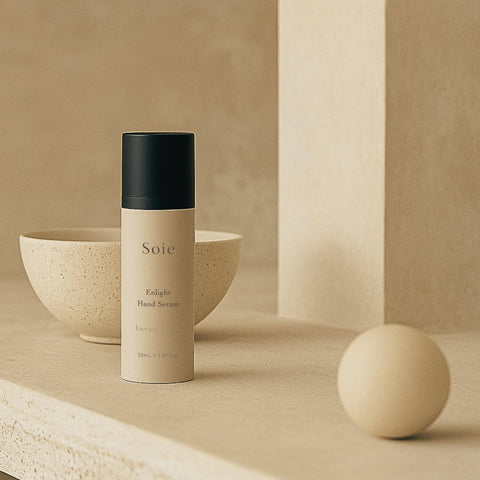
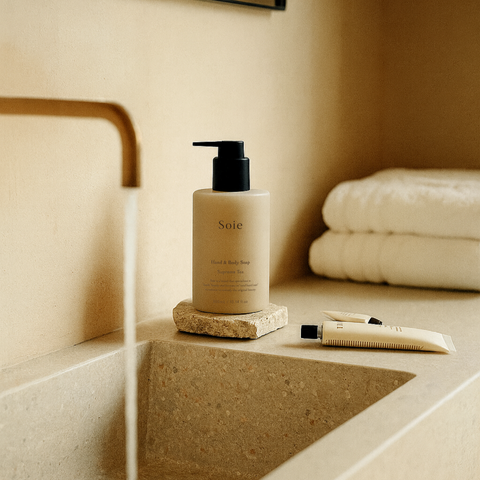
Soie (pronounced swah; French for silk) is a brand devoted entirely to hand beauty, and our proposal is simple: make washing and moisturising a single habit. For washing, there is Moist Fragrance Hand & Body Soap (300 mL), a beauty soap that moisturises with every wash, leaves no tight feeling and can be used on the body as well. For moisturising, there is Enlight Hand Serum (30 mL), a Japanese hand serum designed only for the hands, with EGF and KGF (skin-conditioning ingredients) and five ceramides and peptides (moisturising ingredients) in a texture that sinks in without stickiness, so it suits a desk or a handbag.
Both come in the same five perfume-grade fragrances, LUXURY FLORAL, ELEGANT TIME, COLOR DROPS, SUPREME TEA and SAKURA, so the scent layers naturally when you wash and moisturise with the same one. A daily hand care routine that you look forward to: that is what we hope to offer.
Soie products
 Enlight Hand Serum - LUXURY FLORAL -
 Enlight Hand Serum - ELEGANT TIME -
 Enlight Hand Serum - COLOR DROPS -
 Enlight Hand Serum - SUPREME TEA -
 Enlight Hand Serum - SAKURA -
 Moist Fragrance Hand & Body Soap - LUXURY FLORAL -
 Moist Fragrance Hand & Body Soap - ELEGANT TIME -
 Moist Fragrance Hand & Body Soap - COLOR DROPS -
 Moist Fragrance Hand & Body Soap - SUPREME TEA -
 Moist Fragrance Hand & Body Soap - SAKURA -
From the Hand Beauty Journal
- 2024.09.19How to Apply a Hand Serum: Amount, Order, Timing and TechniqueRead more →
- 2024.08.22How to Wash Your Hands Without RoughnessRead more →
- 2024.12.19An Evening Ritual for the Hands: Caring for Them at the Close of the DayRead more →
- 2024.10.03Hand Beauty at Work: One Bottle on the Desk, and a Light Hand with ScentRead more →
- 2026.08.27Six Common Misunderstandings About Hand Care, Set StraightRead more →
Related guides
- 01Hand care basics
- 02What is a hand serum
- 03Choosing a hand soap
- 04Hand fragrance
- 05Beautiful hands
- 06Aging hands
- 07Dry, rough hands
- 08Sun protection for hands
- 09Overnight care
- 10Nails and fingertips
- 11Men's hand care
- 12Hard-working hands
- 13Bridal hand care
- 14Hand care gifts
Hand serum
Hand care basics
Hand concerns